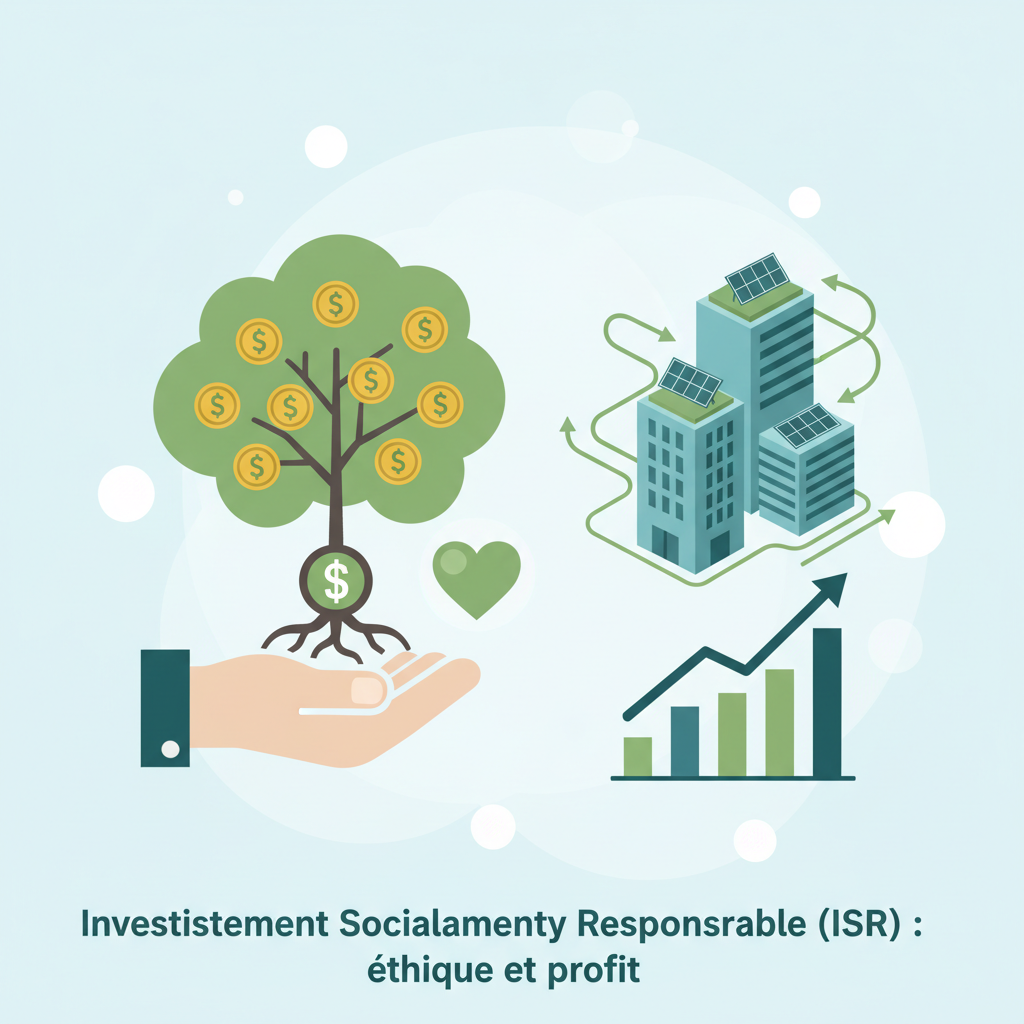
In a world seeking purpose, Socially Responsible Investing (SRI) is emerging as a powerful solution for investors wishing to align their values with their financial strategies. Far from being a mere trend, SRI represents a mature investment approach, proving that it is possible to generate profit while contributing positively to society and the environment.
Socially responsible investing (SRI) allows for the combination of financial performance and positive impact by selecting investments based on environmental, social, and governance (ESG) criteria. Labeled funds and sustainable equity impact investing offer opportunities for sustainable finance and ethics that meet the expectations of modern investors.
Socially Responsible Investing (SRI): Combining Ethics and Profit
1. Understanding Socially Responsible Investing (SRI)
Socially responsible investing (SRI) is an approach that integrates environmental, social, and governance (ESG) criteria into investment decisions and portfolio management. It is no longer solely about maximizing financial returns, but also about considering the impact of companies on the planet, their employees, their customers, and their governance models. It is a comprehensive approach to sustainable finance.
The Pillars of ESG Criteria
ESG criteria are the heart of SRI:
- Environmental (E): Waste management, greenhouse gas emissions, energy consumption, use of natural resources, and biodiversity protection policies.
- Social (S): Employee rights, working conditions, health and safety, staff training, relations with suppliers and local communities, diversity, and inclusion.
- Governance (G): Executive transparency, board independence, anti-corruption measures, executive compensation, and internal auditing. These criteria make it possible to evaluate the sustainability and responsibility of companies beyond financial indicators alone.
2. Why Choose SRI? Beyond Ethics
Interest in SRI is not limited to a purely ethical approach. An increasing number of studies demonstrate that companies performing well on ESG criteria are often more resilient, innovative, and, ultimately, more profitable.
The Benefits of SRI for the Investor
- Risk Management: Companies with strong ESG practices are generally better prepared for regulatory, climate, and social challenges, thereby reducing certain financial risks.
- Financial Performance: Contrary to popular belief, SRI does not sacrifice profitability. Many SRI funds outperform their traditional counterparts over the long term.
- Alignment of Values: SRI allows for investing in accordance with personal convictions, contributing to a positive impact.
- Innovation and Sustainability: Companies committed to an ESG approach are often at the forefront of innovation and better positioned for future challenges.
3. Different Approaches to Sustainable Investment
SRI comes in several methods, allowing investors to choose the approach that best fits their objectives.
Selection and Exclusion
- Negative Exclusion: Excluding controversial sectors or companies (tobacco, weapons, coal, gambling).
- Positive Selection: Prioritizing companies that are the most advanced in ESG criteria within their sector.
- Best-in-Class: Investing in the top-rated ESG companies, regardless of their sector.
Shareholder Engagement and Impact Investing
- Shareholder Engagement: Using one's role as a shareholder to influence the ESG policies of companies.
- Impact Investing: Specifically aims to generate a measurable social and/or environmental impact in addition to a financial return. Consider sustainable equity impact investing for concrete projects.
4. How to Invest in SRI? Tools and Labeling
For an investor, access to SRI is increasingly simple thanks to a diversified offering.
Labeled SRI Funds
Labeled SRI funds are investment vehicles whose management adheres to strict ESG criteria and are audited by independent bodies. In France, the SRI Label is a major reference. It guarantees transparency and a rigorous ESG methodology.
- SRI Equity Funds
- SRI Bond Funds
- SRI Diversified Funds
Other Sustainable Investments
- Green Bonds: Financing environmental projects.
- Microfinance: Supporting entrepreneurs in developing countries.
- Direct Investments: Participating in the capital of companies with high social or environmental impact.
5. Challenges and Transparency in Sustainable Finance
Despite its success, SRI faces challenges, notably "greenwashing," where some marketing offers are greener than the actual products.
Ensuring Real Ethics and Finance Advice
- Independent Labels: Prioritize funds benefiting from recognized labels (SRI Label in France, LuxFLAG in Europe, etc.).
- Reporting Transparency: Verify that management companies publish clear reports on ESG integration and the impact of their investments.
- In-depth Analysis: Do not settle for declarations; critical analysis is necessary.
- Diversification: As with any investment, diversification is key, even in SRI. Socially responsible investing is not just a matter of conscience; it is also a lever for performance and resilience for a sustainable future.
| SRI Criterion | Potential Impact | Reduced Risk |
|---|---|---|
| CO2 Reduction | Environmental | Regulatory |
| Working Conditions | Social | Reputational |
| Transparent Governance | Governance | Fraud / Corruption |
| Sustainable Innovation | Financial / Environmental | Market Obsolescence |
- Failing to check fund labeling, risking "greenwashing."
- Forgetting that SRI is a stock market investment, subject to market fluctuations, and not a guarantee of return.
- Focusing solely on the ethical aspect while neglecting the underlying financial analysis of the companies or funds.
- Define your values and financial goals to target the SRI approaches that suit you (exclusion, impact, etc.).
- Look for financial labeled SRI funds recognized for their rigor and transparency (e.g., SRI Label in France).
- Consult the ESG reports of funds and companies to understand their strategy and real impact.
- Integrate SRI into a global and diversified sustainable finance strategy, seeking advice from a professional if necessary.
- Autorité des Marchés Financiers (AMF) | https://www.amf-france.org
- SRI Label | https://www.lelabelisr.fr
- Forum pour l'Investissement Responsable (FIR) | https://www.faire-face.fr
What distinguishes SRI from a traditional investment? The main difference lies in the integration of ESG (Environmental, Social, Governance) criteria in addition to financial considerations when selecting investments. Is SRI less profitable? No, many studies show that SRI funds can be as, if not more, performant than traditional funds over the long term, thanks to better risk management and increased innovation capacity. How can I be sure a fund is truly SRI? Check for the presence of recognized labels (such as the SRI Label in France) and consult the fund's transparency reports, which detail their ESG methodology and the impact of their investments.