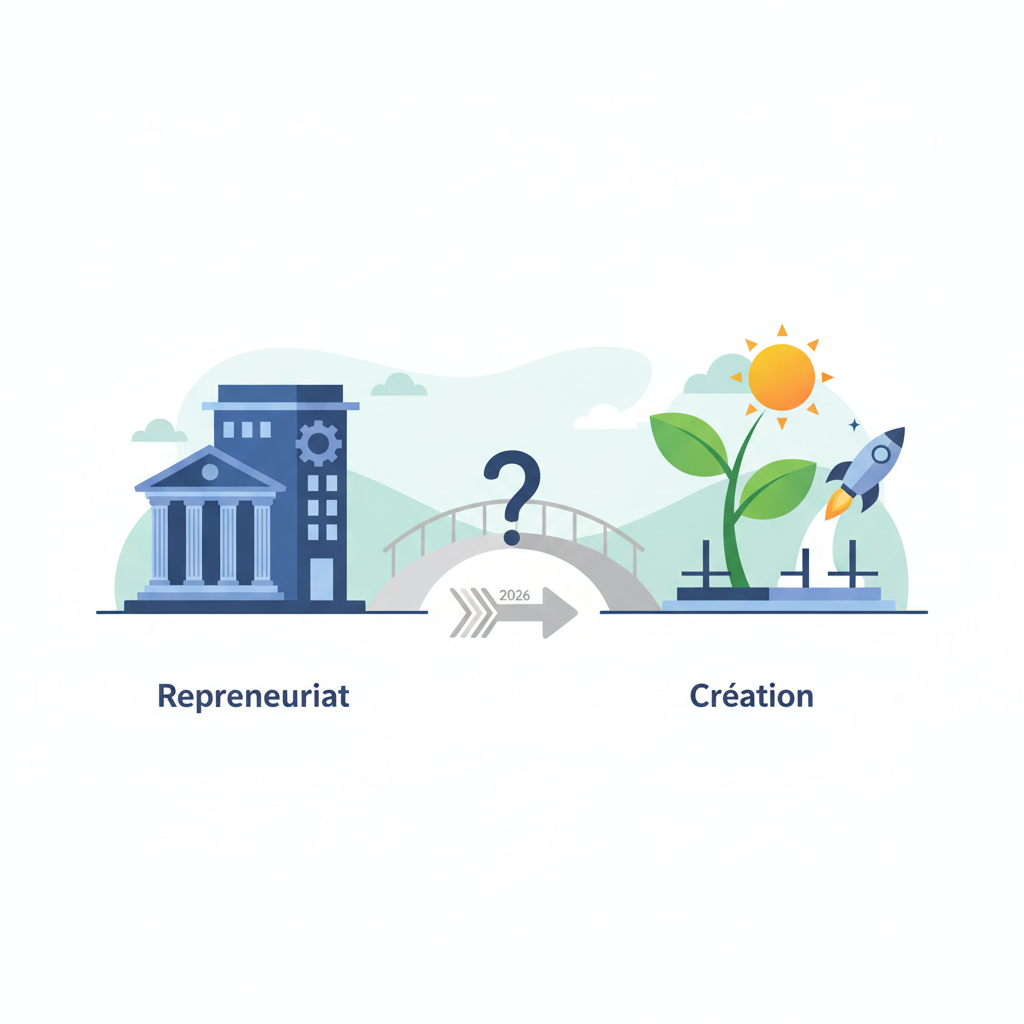
The entrepreneurial landscape is constantly evolving, offering diverse opportunities for investors eager to get involved. In 2026, the question remains: should you launch a business from scratch or opt for acquisition entrepreneurship? This strategic choice, fraught with consequences, deserves an in-depth analysis to maximize your chances of entrepreneurial success.
In 2026, acquisition entrepreneurship often offers a less risky and faster path to entrepreneurial success thanks to an existing customer base and a proven business model. Starting a business, while potentially more lucrative in the long term, requires more capital and time to establish itself. The best choice will depend on your risk appetite and available resources.
Acquisition vs. Startup: Strategic Investment in 2026
1. Acquisition Entrepreneurship: A Springboard to Success?
Acquisition entrepreneurship, or buying an existing business, presents numerous advantages for the savvy investor. Rather than starting from zero, you purchase an already functional structure with a proven track record.
Key Assets of Business Acquisition
- Reduced initial risk: The company has already proven itself in the market. It often has an established clientele, revenue, and existing cash flow. This minimizes the uncertainty inherent in the startup phase.
- Easier access to financing: Banks and other lending institutions are generally more inclined to finance an SME buyout than a startup, as the risk is perceived to be lower.
- Time savings: No need to develop a product, build a brand, recruit a team, or establish processes. You take over an operation already in place, which accelerates your market entry.
- Potential synergies: If you already own a business, acquisition entrepreneurship can create operational, commercial, or technological synergies, thereby increasing overall value. However, acquisition is not without its challenges. Rigorous due diligence is essential to identify hidden liabilities, operational issues, or risks related to corporate culture. Negotiating the right price and integrating new leadership can also be complex.
2. Starting a Business: The Innovation Bet
Starting a business, on the other hand, appeals through the freedom and unlimited innovation potential it offers. It is the preferred path for visionary entrepreneurs wishing to build from the ground up with an entirely new idea.
Advantages of Starting ex nihilo
- Total freedom: You build your company in your image, with your own vision, culture, and values.
- Exponential growth potential: If your product or service meets an unmet need or creates a new market, the profitability potential can be exceptional.
- Innovation: Startups are the cradle of innovation and disruption. It is the opportunity to create cutting-edge solutions, such as in healthtech or artificial intelligence.
- No historical liabilities: You do not inherit the past problems of an existing company. Despite these attractions, starting a business is inherently riskier. Startup failure rates are high, and it takes time, considerable resources, and an unparalleled ability to adapt to reach profitability.
3. Key Factors for Investors in 2026
Your decision between buying a business or starting one should be guided by several strategic factors specific to the 2026 economic environment.
- Industry sector: Certain sectors, such as healthtech or the energy transition, offer excellent startup opportunities thanks to technological innovations. Others, like traditional services, may be more conducive to acquisition entrepreneurship to consolidate the market.
- Your risk profile: Are you comfortable with the high uncertainty of a startup, or do you prefer the relative security of an established business?
- Capital availability: Startups often require significant initial investments without a guarantee of quick returns, while an SME buyout can be financed more easily based on existing cash flows.
- Your expertise: Do you have deep knowledge of a specific market? Starting a business may be the way to capitalize on that. Are you an excellent manager? Acquisition entrepreneurship will allow you to optimize an existing structure.
- The supply market: In 2026, many Baby Boomers are approaching retirement, creating a favorable market for SME buyouts for savvy investors looking to take over a business.
4. Strategies for Optimizing Entrepreneurial Success
Whether you choose acquisition entrepreneurship or a startup, certain strategies are universally valid to maximize your entrepreneurial success.
For Acquisition Entrepreneurship:
- Thorough due diligence: Meticulously analyze the financial, operational, legal, and social health of the target company.
- Solid transition plan: Establish a clear plan for taking over the business and managing change with employees and customers.
- Identify growth levers: Do not settle for maintenance; look to develop the business (new offerings, markets, process optimization).
For Startups:
- Market validation: Ensure there is a real need for your offering and that you have a clear competitive advantage.
- Strong founding team: A competent and multidisciplinary team is crucial for navigating initial challenges.
- Viable business model: Define how the company will generate revenue and be profitable in the long term.
- Flexibility and agility: Be ready to pivot and adapt to market feedback.
| Criterion | Acquisition (2026) | Startup (2026) | Level |
|---|---|---|---|
| Initial Risk | Low to Moderate | High | 2/5 vs 4/5 |
| Startup Time | Fast | Long | 1/5 vs 4/5 |
| Financing | More Accessible | More Complex | 4/5 vs 2/5 |
| Creative Freedom | Limited | Total | 2/5 vs 5/5 |
| Innovation Potential | Moderate | High | 3/5 vs 5/5 |
| Customer Base | Existing | To Be Built | 5/5 vs 1/5 |
| Acquisition Cost | Variable (High) | Variable (Low to High) | 3/5 vs 3/5 |
- Ignoring due diligence in acquisitions: Failing to sufficiently analyze hidden liabilities or operational risks can turn an opportunity into a financial pitfall.
- Underestimating costs and timelines in startups: The capital required and the time to reach break-even are systematically undervalued, leading to fund exhaustion.
- Neglecting the human dimension: Whether it is the corporate culture to be integrated during a buyout or the cohesion of the founding team in a startup, the human aspect is often the key to entrepreneurial success.
- Self-assess your investor profile: Determine your risk appetite, skills, and financial resources.
- Identify growth sectors in 2026: Look for growth opportunities in fields like healthtech, AI, or the green economy.
- Conduct in-depth research: Study businesses for sale (for acquisition) or intensively validate your market ideas (for startups).
- Consult experts: Lawyers, accountants, M&A experts, or incubators to refine your strategy and secure your journey.
- Bpifrance Le Lab | https://www.bpifrance-lelab.fr/
- France Num | https://www.francenum.gouv.fr/
- Chambers of Commerce and Industry (CCI) | https://www.cci.fr/
Is acquisition entrepreneurship always less risky than a startup? Acquisition entrepreneurship generally reduces risks related to starting up (clientele, product, initial finances), but carries its own risks (hidden liabilities, integration, valuation). Proper due diligence is crucial to minimize the latter. How do I find a business to acquire in 2026? Specialized platforms, M&A firms, Chambers of Commerce and Industry (CCI), or professional networks are excellent resources for finding businesses for sale, especially SMEs. Is healthtech a good sector for a startup in 2026? Yes, absolutely. The healthtech sector is experiencing exponential growth, fueled by technological advances and an aging population. It offers enormous opportunities for innovation and high-potential business creation.