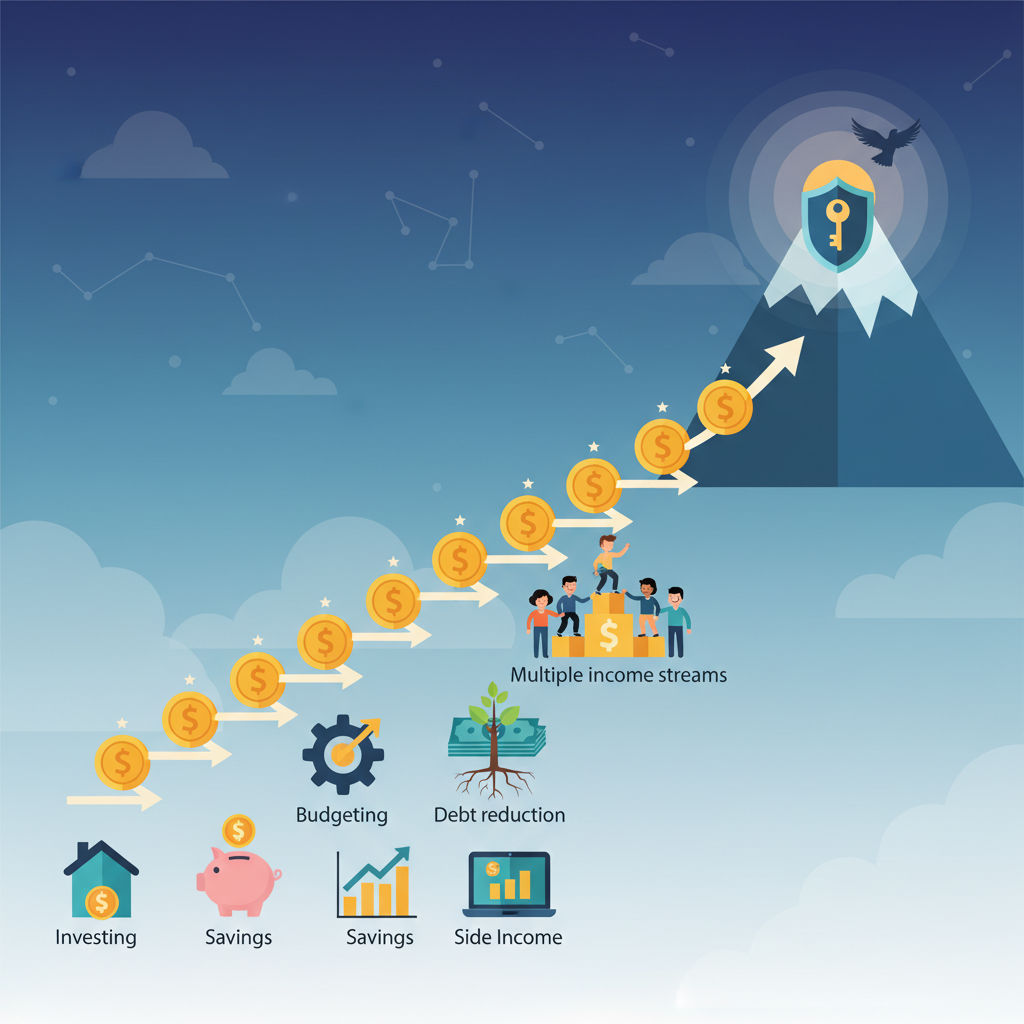
Achieving financial independence is an ambitious goal that attracts an increasing number of investors. It is not just a matter of money, but a quest for a financial freedom steps guide that allows one to live without depending on a salary, to choose one's own schedule, and to pursue one's passions. This article is your roadmap to understanding and implementing the strategies leading to this highly sought-after autonomy.
Financial independence is achieved by maximizing savings, investing wisely in passive income financial diversification, and reducing expenses. The method involves first defining your FIRE goal, then building wealth through investment and active financial management to generate sufficient income to cover your cost of living without working.
The Financial Independence Method: Achieving Freedom
The financial independence method is not a myth, but an achievable goal through rigorous planning and financial discipline. It is defined as the ability to cover your living expenses through your passive income financial diversification, without the need for a salary from active work. This often involves rethinking your relationship with money, savings, and investment to create sufficient capital.
1. Understanding the FIRE Movement: A Global Approach
The FIRE (Financial Independence, Retire Early) movement is gaining popularity, particularly in France. It is not necessarily about "retiring" at 40, but rather acquiring the freedom to choose. The precepts of FIRE movement France tips are based on three pillars:
- Aggressive savings: Setting aside a very significant portion of your income (often 50% or more).
- Smart investing: Making your money work for you to generate passive income.
- Expense reduction: Optimizing your budget to minimize your annual cost of living. The goal is to accumulate 25 times your annual expenses to be able to live off the income generated by this capital, according to the 4% rule (withdrawing 4% of your capital each year without exhausting it).
2. Defining Your Goals and Financial Plan
The first concrete step toward the financial independence method is to clarify your goals. What is your ideal annual cost of living? At what age do you wish to reach this goal?
- Calculate your FIRE "magic number": Multiply your annual expenses by 25. This is the capital you will need.
- Establish a detailed budget: Track your expenses and identify areas where you can save. This is the foundation of your savings capacity.
- Set a high savings rate: Aim for a savings rate above the average. The more you save, the faster you will reach your goal.
The Importance of a Precise Budget
A budget is not a constraint, but a powerful tool. It allows you to visualize where your money is going and to make informed decisions to increase your savings. Every euro saved is a euro working toward your financial freedom steps guide.
3. Investment Strategies for Passive Income
Once your savings are maximized, the crucial step is investing to generate passive income financial diversification.
- Stock markets: Investing in ETFs (Exchange Traded Funds) or shares of large companies via a PEA (Equity Savings Plan) or a securities account. Diversification is essential.
- Rental real estate: Acquiring property to generate monthly rental income. This can be an excellent source of passive income but requires active management at the start.
- Corporate dividends: Owning shares in companies that pay regular dividends.
- Entrepreneurship and digital assets: Creating a business that generates recurring income or investing in digital assets. The key is the diversification of your investments to reduce risk and optimize returns.
4. Managing Leverage and Reducing Debt
The judicious use of leverage, particularly through real estate, can accelerate the achievement of financial independence. However, debt must be managed with caution.
- Repaying high-interest debt: Prioritize paying off consumer loans and credit card debt before any investment.
- "Healthy" debt: A low-interest mortgage can be considered healthy debt if it is used to acquire an income-generating asset. The goal is to minimize financial costs that eat away at your capital and your savings capacity.
5. The Transition Phase: Leaving Your Job and Maintaining Your Wealth
When your passive income is sufficient to cover your expenses, it is time to consider leaving your job equity investment.
- Test your passive income: Before resigning, ensure your passive income is stable and predictable over a significant period.
- Maintain an emergency fund: Keep at least 6 to 12 months of expenses aside to handle the unexpected.
- Continue managing your investments: Financial independence does not mean inactivity. Managing your portfolio and adjusting your strategies remain crucial.
Equity Investment: An Opportunity
Investing in equity (shares, company stakes) means taking direct stakes in companies, potentially high-growth ones, which can accelerate wealth accumulation and offer attractive long-term returns for savvy investors.
| Criterion | Advantage | Impact Level |
|---|---|---|
| High savings rate | Accelerates capital accumulation | High |
| Inv. diversification | Risk reduction, income stability | High |
| Debt reduction | Increases available capital | Medium |
| Financial education | Better investment decisions | High |
| Passive income | Freedom of time and personal choices | Very High |
- Not having a precise budget: Impossible to know your real savings rate and areas for improvement.
- Investing without training or diversification: High risk of losses and delaying the goal.
- Neglecting inflation: The purchasing power of your capital may decrease if this factor is not taken into account.
- Not having an emergency fund: A major unforeseen event can ruin years of financial effort.
- Calculate your annual expenses and your FIRE "magic number."
- Establish a detailed budget and identify 3 expense categories to significantly reduce.
- Open an investment account (PEA, Securities account) and plan your first diversified investment.
- Set up a monthly automatic transfer to your savings/investment account.
- The Flip Side of the Coin | https://blogs.worldbank.org/fr/voices/la-trappe-de-l-endettement-les-dettes-de-credit-card-une-menace-pour-la-stabilite-financiere-des
- Autorité des Marchés Financiers | https://www.amf-france.org/fr/espace-epargnants/comprendre-les-produits-financiers/produits-d-investissement/les-placements-actions
What percentage of income should I save for financial independence? While it depends on your time horizon, the FIRE movement often advocates saving at least 50% of your income, or even more for early retirement. Is real estate the best investment for passive income? Rental real estate is an excellent source of passive income, offering stability and leverage. However, it should not be the only option. Diversification with other assets like the stock market is crucial. Is it too late to start my quest for financial independence? It is never too late to start. Every euro saved and invested is one step closer to your goal. The important thing is to start, even modestly, and to be consistent.