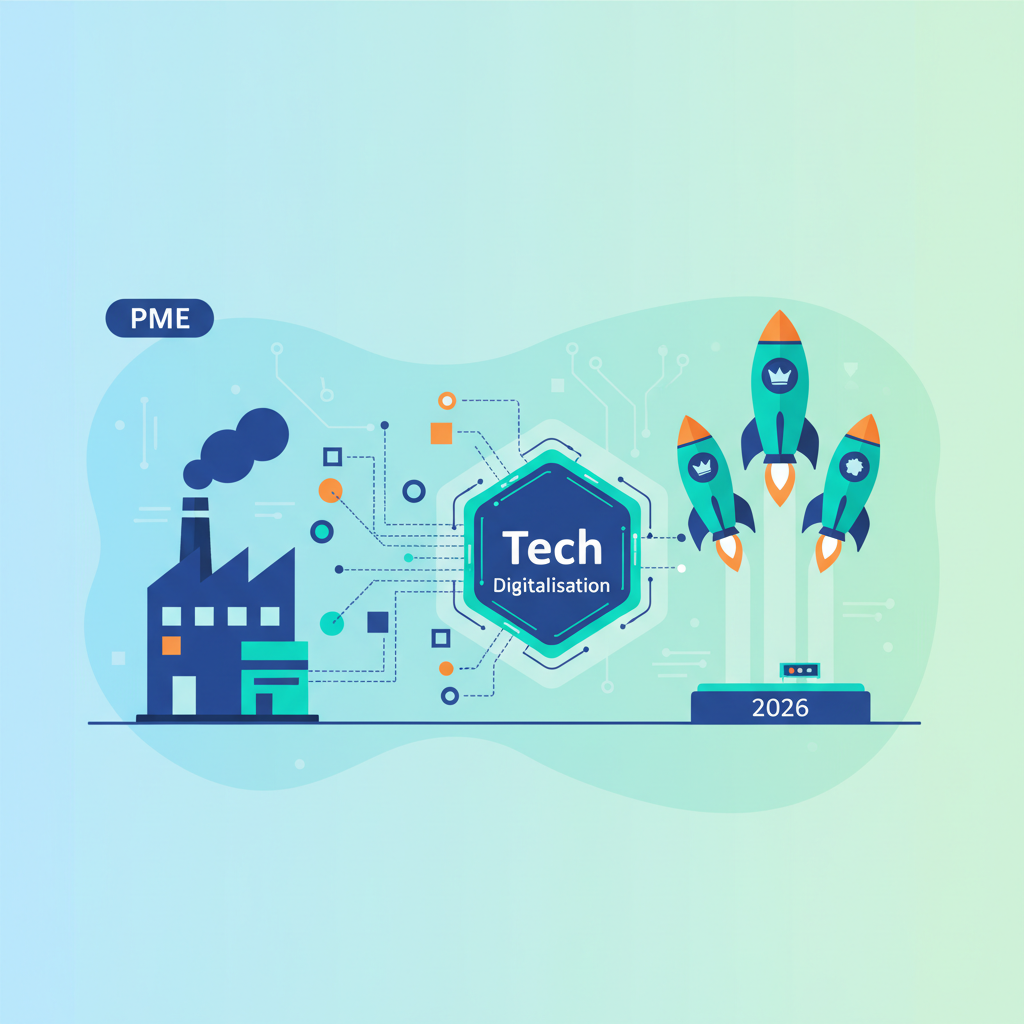
Today's constantly evolving economic landscape is forcing companies to reinvent themselves. For savvy investors, tech-driven SME acquisition (repreneuriat) is not only a growth opportunity but also a powerful lever to digitalize established players and propel them toward sustainable leadership by 2026.
Tech acquisition is the key strategy for transforming traditional SMEs into agile and competitive enterprises by infusing technology to boost innovation and performance. This approach offers investors considerable value creation potential by revitalizing existing assets.
Tech Acquisition: A Catalyst for SME Leadership in 2026
The concept of tech-driven SME acquisition is much more than a simple transaction. It is an investment philosophy aimed at acquiring existing companies—often traditional or industrial—to inject a strong technological component and revitalize them. The objective is clear: position them as market leaders by 2026, potentially transforming a stable but stagnant asset into an innovation champion.
1. Understanding Tech Acquisition: Definition and Opportunities
Tech acquisition manifests through the purchase of a mature company, typically an SME, with the intent to integrate advanced digital solutions, automated processes, and a data-driven culture. This is not merely a financial buyout, but a transformation strategy where the investor brings more than just capital: they inject a technological vision and growth ambition.
Opportunities for investors in this field are manifold:
- Valuation of undervalued assets: Many SMEs possess solid expertise and a loyal customer base but lack technological agility.
- Growth acceleration: The digitalization of traditional businesses can unlock new markets and optimize operations.
- Long-term value creation: By modernizing the company, its longevity and competitiveness against new disruptions are secured.
Why are traditional SMEs prime targets?
SMEs are often held back by:
- A lack of internal technological expertise.
- Limited investment budgets for R&D.
- A natural resistance to change. A tech-focused acquirer provides the necessary momentum to overcome these obstacles and breathe new life into the business.
2. Buyout and Modernization Strategies through Tech Acquisition
A 2026 startup buyout strategy in the context of tech acquisition involves a deep analysis of potential synergies. It is not about "destroying to rebuild," but rather optimizing what already exists. The integration of key technologies can span several areas:
- Management Software (ERP/CRM): To centralize data and automate administrative, financial, and commercial processes.
- Advanced Production Tools: Robotics, AI, and IoT for Industry 4.0 and industrial business acquisitions.
- E-commerce and Digital Marketing Platforms: To expand market reach and improve customer relationships.
- Data Analytics (Business Intelligence): To make informed decisions and anticipate trends.
The goal of modernization through tech acquisition is to shift from a "reactive" model to a "proactive" and "innovative" one.
3. Keys to Success for a Successful Tech Acquisition
For an investor, several factors are decisive in turning a tech-driven SME acquisition into a significant success:
- Thorough Technological Audit: Before the acquisition, a precise assessment of existing systems and future needs is essential.
- Hybrid Management Team: Retaining the expertise of current leaders while integrating tech-oriented and innovation-driven profiles.
- Change Management: Supporting teams in adopting new technologies and working methods.
- Clear Technological Roadmap: Defining precise and measurable steps for the digitalization of the traditional business.
- Strategic Financing: Allocating substantial budgets not only for the acquisition but also for post-acquisition technological investment.
4. Measuring the Impact and Profitability of Digital Transformation
The profitability of a tech acquisition is measured through several key indicators, demonstrating the added value of traditional business digitalization:
- Revenue growth: Market expansion, new digital products/services.
- Operating margin improvement: Cost optimization through automation and increased efficiency.
- Increased customer satisfaction: Through faster and more personalized services.
- Talent attraction: A modernized company is better at attracting and retaining skilled workers.
- Market or resale valuation: A technologically advanced company has an intrinsically higher market value.
This creates a virtuous cycle where the initial investment in technology generates superior returns and supports sustainable growth.
| Criterion | Advantage | Level |
|---|---|---|
| Growth Potential | New markets, increased efficiency | High |
| Cost Reduction | Automation, process optimization | Moderate to High |
| Market Resilience | Capacity for innovation and adaptation | Very High |
| Investor Attractiveness | Future valuation, leadership | High |
- Failing to assess the existing corporate culture and its capacity to accept change.
- Underestimating the cost and time required for a complete digitalization of a traditional business.
- Focusing solely on technology without evaluating its alignment with the actual needs of the market or the SME.
- Target Identification: Look for SMEs with strong expertise but a weak technological presence.
- In-depth Audit: Conduct technological, financial, and human due diligence.
- Digitalization Plan: Establish a clear, budgeted technological roadmap for the post-acquisition phase.
- Change Management Support: Provide a budget and resources for training and the integration of new solutions.
- Bpifrance | https://www.bpifrance.fr/
- France Num | https://www.francenum.gouv.fr/
- EY | https://www.ey.com/en_gl
- KPMG | https://home.kpmg/xx/en/home.html
What is the main risk of tech-driven SME acquisition? The main risk is the failure of technological integration or resistance to change from teams, which can hinder the transformation and expected profitability.
How long does it take to see results from the digitalization of a traditional business? It depends on the scope of the changes, but the first impacts (efficiency, new services) can be visible within 12 to 24 months, with significant returns on investment within 3 to 5 years.
Is tech acquisition suitable for all sectors? Yes, from manufacturing to logistics to services, all sectors can benefit from modernization through tech acquisition. Opportunities are often greatest in fields that are traditionally less digitalized.