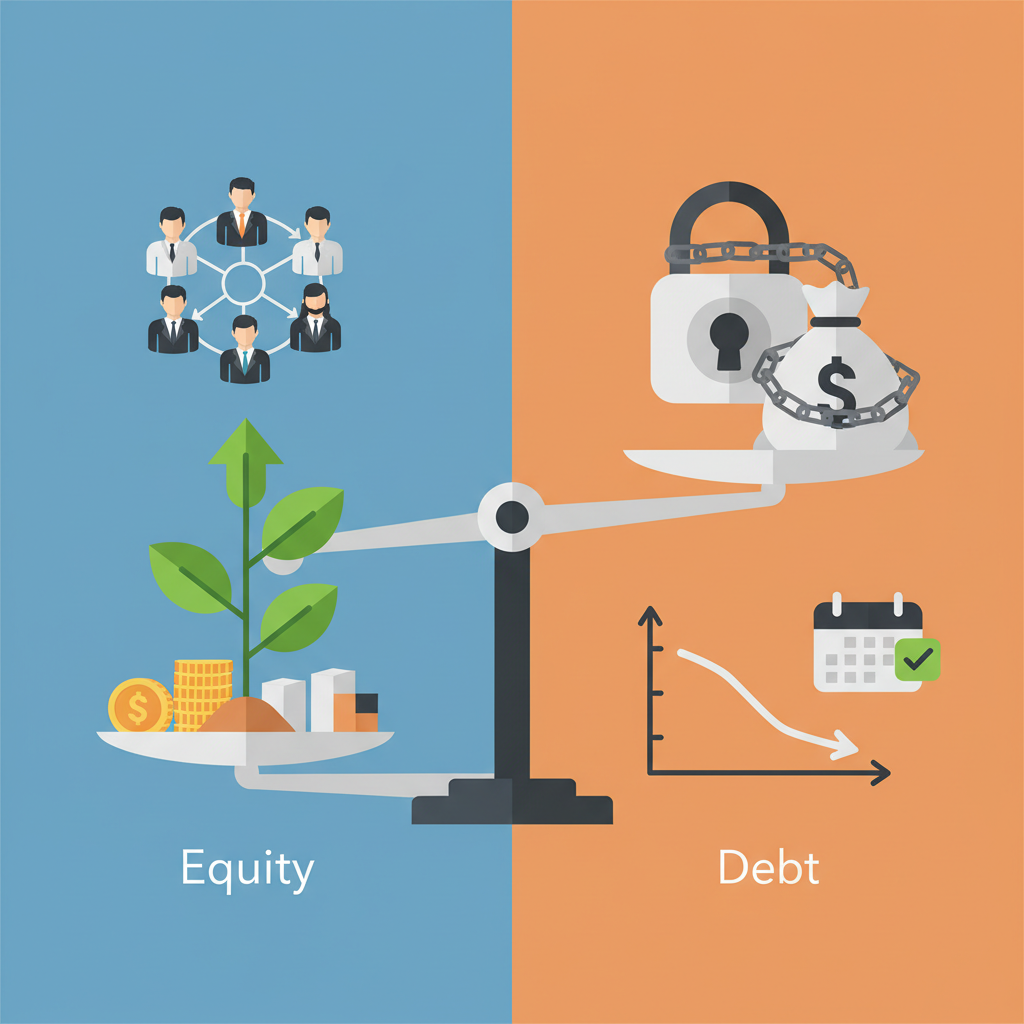
As an investor or business leader, the decision to finance your growth through equity vs debt finance is one of the most strategic choices you will make. This choice shapes not only the financial health of your organization but also its autonomy and return potential. Let’s dive into this complex issue to guide your journey.
The choice between equity (shareholders' equity) and debt depends on growth objectives, risk tolerance, and control. Equity dilutes ownership but provides funds without fixed repayments, while debt maintains control but creates repayment obligations with interest, impacting cash flow.
1. Understanding Equity: Pros and Cons for Investors
Equity (or shareholders' equity) represents the capital contribution made by owners or external investors in exchange for shares in the company. This is a form of beneficial corporate financing in many cases.
Advantages of Equity
- Less short-term financial pressure: Unlike debt, there are no regular repayment obligations, providing valuable flexibility, especially for startups or companies in volatile growth phases.
- Strengthened credibility: The arrival of new shareholders, particularly recognized investment funds, can signal strong market approval and facilitate access to other funding sources.
- Shared risk and expertise: Equity investors share the company's risks and often provide strategic expertise, a network, and valuable advice beyond simple capital.
- Increased borrowing capacity: A high level of equity improves the company's creditworthiness and its ability to secure loans later, as it reduces the debt-to-equity ratio.
Disadvantages of Equity
- Dilution of ownership and control: Every new equity investor acquires a portion of the company, thereby diluting the stake of existing shareholders and potentially their decision-making power.
- High long-term cost: Equity investors expect a significant return on investment, often higher than the cost of debt, as they take on higher risk. This return can materialize through dividends or capital gains upon exit.
- Complex fundraising process: Searching for and negotiating with equity investors can be time-consuming, expensive, and resource-intensive.
2. Debt: Maintaining Control vs. Fixed Charges
Debt financing involves borrowing funds from financial institutions or other lenders, with a commitment to repay the principal and interest according to a predefined schedule.
Advantages of Debt
- Maintenance of control: Lenders do not acquire shares in the company, allowing founders and existing shareholders to retain full ownership and decision-making power.
- Often lower cost: Interest on debt is generally tax-deductible, which reduces its net cost. Furthermore, for established companies, interest rates may be lower than the returns expected by equity investors.
- Predictability of payments: Debt repayments are fixed in advance, facilitating financial planning and cash flow management.
- Financial leverage: Using debt to finance profitable investments can amplify returns for existing shareholders.
Disadvantages of Debt
- Fixed repayment obligations: Interest and principal payments must be made regardless of the company's performance. Failure to do so can lead to penalties or even bankruptcy.
- Constraints and covenants: Lenders often impose restrictive clauses (covenants) limiting certain company actions (e.g., maximum debt levels, maintenance of certain financial ratios).
- Increased financial risk: Excessive debt levels can make the company vulnerable to market fluctuations or revenue declines, increasing the risk of default.
- Requires collateral: Lenders often require collateral (company assets, personal guarantees) to secure the loan.
3. Equity vs Debt Finance: Key Factors for Choosing Financing
The optimal choice between equity vs debt finance is never simple and depends on several crucial factors related to the company's capital structure and its objectives.
Stage of Business Development
- Start-up/Early Stage: Often, equity is preferred because debt is difficult to obtain without a revenue history or substantial collateral. Equity investors are more willing to take risks on future potential.
- Growth: A mix of both is common. Debt can finance working capital needs or predictable investments, while equity can support riskier R&D projects or rapid expansion.
- Maturity: Established companies have easier access to debt on favorable terms due to their stable cash flows and assets.
Cost of Capital
Evaluate the true cost of each option, taking into account interest for debt (after taxes) and the expected return for equity investors. The cost of equity is often higher because it includes a risk premium.
Control and Dilution
If maintaining total control is a priority, debt is the preferred option. If dilution is acceptable in exchange for capital and expertise, equity may be more attractive.
Risk Tolerance
A company with stable cash flows can better absorb debt. A company with unpredictable revenues might prefer the flexibility of equity to avoid repayment pressure during lean periods.
4. Capital Structure Strategies: Finding the Optimal Balance
Capital structure is the balance between debt and equity used to finance a company's operations. The goal is to minimize the Weighted Average Cost of Capital (WACC) while maximizing the company's value.
Financial Leverage
The judicious use of debt can create financial leverage. If the return on assets financed by debt is higher than the cost of that debt, the surplus benefits the shareholders, increasing their return. However, this effect is a double-edged sword in the event of underperformance.
Maintaining Flexibility
It is crucial to maintain a certain degree of flexibility. Too much debt can make the company vulnerable and limit its ability to borrow more in the event of unforeseen opportunities or difficulties. Too much equity can be expensive and excessively dilute ownership.
5. Hybrid Financing: The Best of Both Worlds?
Certain instruments sit halfway between equity and debt, offering characteristics of both. They can be interesting solutions for financial financing choices.
Convertible Bonds
These bonds can be converted into company shares under predefined conditions. They offer the security of debt with the upside potential of equity for the investor, and initially less dilutive financing for the company.
Subordinated Loans and Mezzanine Finance
These are forms of debt that rank below senior debt in the event of liquidation but above equity. They are often accompanied by equity warrants, allowing lenders to also benefit from the company's growth. This financing is more expensive than traditional debt but less dilutive than pure equity.
| Criteria | Equity Financing | Debt Financing |
|---|---|---|
| Dilution | Yes, sharing of ownership and control | No, no dilution of control |
| Repayment Oblig. | No, expectation of capital gains/dividends | Yes, fixed repayments (principal + interest) |
| Cost | Potentially high (expected return) | Generally lower (tax deductibility) |
| Business Risk | Shared with investors | Increases bankruptcy risk if unable to repay |
| Flexibility | High flexibility (no fixed payments) | Less flexible (covenants, maturities) |
| Credibility | Strengthened by renowned investors | Improved by a low debt-to-equity ratio |
- Ignoring the true cost of capital: Failing to evaluate the impact of taxes, transaction fees, and expected investor returns on the overall cost of each option. A superficial calculation can lead to an imbalanced capital structure.
- Underestimating control dilution: Considering only the capital contribution without anticipating the implications for governance and decision-making power. Debt vs equity fundraising has a lasting impact on the company.
- Excessive borrowing: Failing to consider the company's repayment capacity and the risks inherent in heavy debt, particularly in an uncertain economic environment.
- Analyze your immediate and future needs: Clearly define the purpose of the financing (growth, working capital, acquisition) and the required duration.
- Model financial scenarios: Evaluate the impact of each option (equity vs debt finance) on your cash flow, profitability, debt levels, and valuation in the short and long term.
- Evaluate your tolerance for dilution/control: Determine to what extent you are willing to share ownership and decisions to obtain the necessary funds.
- Consult financial experts: A financing advisor or investment banker can help you navigate the options and optimize your financial financing choice relative to your specific situation.
- Autorité des marchés financiers (AMF) | https://www.amf-france.org
- Banque de France | https://www.banque-france.fr
- Bpifrance | https://www.bpifrance.fr
When is equity preferable to debt for a startup? Equity is often preferable at the beginning because startups lack the collateral and revenue history to secure debt, and equity investors often provide vital strategic support. Is debt always cheaper than equity? Not systematically. Although debt interest rates are generally lower than expected equity returns, the cost of debt increases with the borrower's risk, and restrictive covenants can limit flexibility, which carries an indirect cost. What are the risks of excessive equity dilution? Excessive dilution can lead to a loss of control for founders, a decrease in motivation if their stake becomes too small, and potential conflicts with new shareholders if visions diverge.